
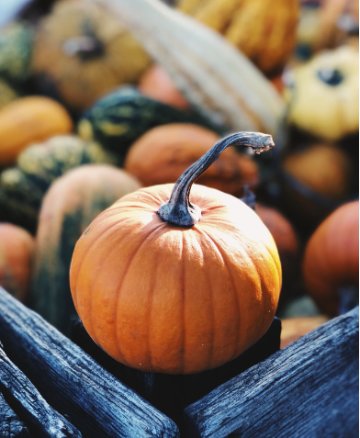
It was December 2, 1948, and a Carroll County farmer led two visitors to the garden behind his house. He stopped when he got to what appeared to be a hollowed-out pumpkin. The farmer stooped down, reached inside the pumpkin, and brought forth a small item wrapped in wax paper, handing it to one of the visitors.
The Carroll County Westminster, Md farmer was a man named Whittaker Chambers (his main job was senior editor for Time magazine in New York) and the visitors were from Washington, D.C., The House Unamerican Activities Committee (HUAC) to be exact. The package in the pumpkin was microfilm and that film would ensure Carroll County’s part in what came to be known as – The Trial of The Century.
Chambers had been a dedicated Communist, beginning in the 1920s and remaining so until 1938. In his autobiography, Witness, he says his break began when he was feeding his infant daughter breakfast and noticed the perfection of her ears. The thought came to mind that only a higher being could create such perfection. The total break came in late 1938 when he failed to deliver some classified documents he’d received from his Communist contact in the State Department, to his Russian contact in New York. Chambers knew he could never go back and from that day kept a loaded revolver close at hand. Had Chambers let things go as they were, he might have lived out his days in relative obscurity. By 1948, he had a $30,000-a-year job with Time and traveled home each weekend to assist his wife and children on their working farm on Bachmans Valley Road in Westminster, Md. Since the Communist Party had sent no one to kill him, they probably weren’t going to.
But Chambers, who by now had embraced Christianity (he attended a Quaker church in Union Bridge) and developed a conscience, knew he had to reveal what he knew about Communism in the U.S. He contacted the FBI and began to name names. The revelation of one of those would shock the country and bring much vituperation down on the head of Whittaker Chambers. While there are still many
who believe Chambers was a scoundrel and a liar; in his defense it must be said he never backed down from his accusations.
Alger Hiss was the fair-haired boy to top all fair-haired boys. Born in Baltimore, and a law school graduate, he had forged a brilliant career in government, was at FDR’s side at Yalta and played a big part in the drafting of the United Nations charter. That a nonentity like Chambers would accuse such a man of being a Communist spy was totally ridiculous.
Why Hiss had clerked for Oliver Wendell Holmes and was a best friend of two current justices! Everybody in Washington loved Alger Hiss!
Well, not everybody.
A young Congressman named Richard Nixon gave credence to Chambers and set about building a case and that case came to trial. They couldn’t try Hiss for espionage due to the statute of limitations, but after his appearances before HUAC in which he denied ever knowing anyone named Whittaker Chambers, it was decided to try him for perjury. The first trial ended in a hung jury, but the second ended in a guilty verdict, resulting in a five-year sentence for Hiss (of which he served three years, entering in March 1951 and being released on November 27, 1954) and, when he died in 1996, he still was declaring his innocence. He survived Chambers by 35 years.
One cannot think about Hiss/Chambers without thinking of the Prince and the Frog. In this case, the prince had the impeccable reputation, but the Frog according to a Washington D.C. jury had the truth.
And how did staid old Carroll deal with Hiss and Chambers? Most of us probably sided with Chambers – after all, he was a farmer – like most of us. I remember one relative saying that “Why-taker-Chambers sure put us on the map.” Well, he did, at least for a little while.
By Don Haines, Carroll Seniors, December 2006